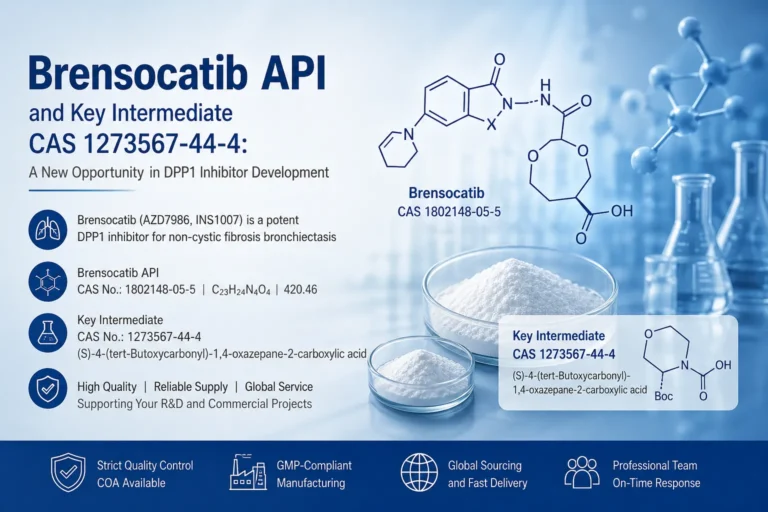
Brensocatib API has become an important molecule in the field of respiratory and inflammatory disease drug development. As a first-in-class dipeptidyl peptidase 1 inhibitor, commonly known as a DPP1 inhibitor, Brensocatib represents a new therapeutic approach for non-cystic fibrosis bronchiectasis and related neutrophil-driven inflammatory diseases.
For pharmaceutical companies, CDMOs, formulation developers, and R&D teams, Brensocatib is not only an approved innovative small-molecule API, but also an attractive target for route evaluation, intermediate sourcing, analytical development, and future generic or follow-on development strategies.
This article introduces Brensocatib API CAS 1802148-05-5, its mechanism of action, therapeutic relevance, and key synthetic intermediates, especially Brensocatib intermediate CAS 1273567-44-4.
What Is Brensocatib API?
Brensocatib is an orally active small-molecule drug substance and a selective DPP1 inhibitor. It is also known by its development codes AZD7986 and INS1007.
DPP1 plays an important role in the activation of neutrophil serine proteases. These enzymes are involved in inflammatory tissue damage, especially in chronic respiratory diseases where excessive neutrophil activity contributes to airway injury and disease progression.
Basic Information of Brensocatib API
| Item | Information |
|---|---|
| Product Name | Brensocatib |
| CAS No. | 1802148-05-5 |
| Molecular Formula | C23H24N4O4 |
| Molecular Weight | 420.46 |
| Drug Class | DPP1 inhibitor |
| Development Codes | AZD7986 / INS1007 |
| Main Therapeutic Area | Respiratory inflammatory disease |
| Dosage Form | Oral tablet |
Brensocatib is marketed under the brand name BRINSUPRI® and has been approved for the treatment of non-cystic fibrosis bronchiectasis, also known as NCFB.
Brensocatib and Non-Cystic Fibrosis Bronchiectasis
Non-cystic fibrosis bronchiectasis is a chronic and progressive lung disease characterized by irreversible airway dilation, mucus accumulation, recurrent infection, persistent inflammation, and repeated pulmonary exacerbations.
Patients with NCFB may experience:
- Chronic cough
- Excessive sputum production
- Recurrent respiratory infections
- Shortness of breath
- Fatigue
- Progressive airway damage
- Frequent need for antibiotics or airway clearance therapy
Historically, treatment options for NCFB have focused mainly on symptom control, infection management, and supportive care. Brensocatib offers a different approach by targeting an upstream inflammatory mechanism associated with neutrophil activation.
This makes Brensocatib API a highly relevant molecule for pharmaceutical companies working in respiratory medicine, chronic inflammatory disease, and specialty small-molecule drug development.
Mechanism of Action: Why DPP1 Inhibition Matters
Brensocatib works by inhibiting dipeptidyl peptidase 1, also called DPP1 or cathepsin C. DPP1 is responsible for activating several neutrophil serine proteases during neutrophil maturation.
These neutrophil serine proteases include:
- Neutrophil elastase
- Cathepsin G
- Proteinase 3
In patients with chronic airway inflammation, excessive activity of these enzymes can contribute to mucus hypersecretion, epithelial injury, airway wall damage, and worsening respiratory symptoms.
By inhibiting DPP1, Brensocatib reduces the activation of these inflammatory enzymes. This mechanism helps explain why Brensocatib has attracted strong interest as a new therapeutic option for neutrophil-driven respiratory diseases.
For API manufacturers and sourcing teams, the DPP1 inhibitor class represents an important area of innovation, especially as more companies evaluate respiratory and inflammatory disease pipelines.
Brensocatib API CAS 1802148-05-5: Why It Attracts Pharmaceutical Interest
The approval and commercialization of Brensocatib have increased global attention toward Brensocatib API CAS 1802148-05-5 and its related intermediates.
Pharmaceutical companies may be interested in Brensocatib API for several reasons:
1. First-in-Class Therapeutic Positioning
Brensocatib is recognized as a first-in-class DPP1 inhibitor for non-cystic fibrosis bronchiectasis. First-in-class molecules often create strong downstream interest from generic companies, CDMOs, research institutes, and formulation developers.
2. Oral Small-Molecule Advantage
Compared with biologics or complex injectable therapies, oral small molecules often have advantages in manufacturing scalability, patient convenience, formulation development, and global commercial accessibility.
3. Growing Demand in Respiratory Disease Research
Respiratory inflammatory diseases continue to receive increasing attention worldwide. Brensocatib provides a new mechanism-based approach to disease management, which may stimulate further R&D activity around DPP1 inhibition and neutrophil-driven inflammation.
4. Importance of Early Intermediate Sourcing
For companies evaluating API development, early access to key intermediates can help accelerate:
- Synthetic route evaluation
- Impurity profile studies
- Analytical method development
- Pilot-scale feasibility assessment
- Cost estimation
- Supplier qualification
- Regulatory preparation
This is why Brensocatib intermediates, especially CAS 1273567-44-4, are becoming important products in pharmaceutical sourcing.
Key Brensocatib Intermediate CAS 1273567-44-4
One of the most important intermediates associated with Brensocatib synthesis is:
| Item | Information |
|---|---|
| Product Name | (S)-4-(tert-Butoxycarbonyl)-1,4-oxazepane-2-carboxylic acid |
| CAS No. | 1273567-44-4 |
| Category | Brensocatib key intermediate |
| Structure Type | Chiral Boc-protected oxazepane carboxylic acid |
| Application | Intermediate for Brensocatib API synthesis |
This compound can be described as:
Brensocatib Intermediate CAS 1273567-44-4
or
(S)-4-(tert-Butoxycarbonyl)-1,4-oxazepane-2-carboxylic acid
It is a chiral protected oxazepane carboxylic acid fragment. In Brensocatib synthesis, this type of intermediate is valuable because it contributes to the final molecular framework of the API.
For customers searching online, common search terms may include:
- Brensocatib intermediate CAS 1273567-44-4
- CAS 1273567-44-4 supplier
- (S)-4-(tert-butoxycarbonyl)-1,4-oxazepane-2-carboxylic acid supplier
- Brensocatib key intermediate
- DPP1 inhibitor intermediate
- Brensocatib intermediate China
- Brensocatib API intermediate supplier
Because this intermediate contains stereochemical features, reliable quality control is essential for downstream API development.
Another Brensocatib-Related Intermediate: CAS 1220696-32-1
In addition to CAS 1273567-44-4, another Brensocatib-related intermediate is:
| CAS No. | Chemical Name |
|---|---|
| 1220696-32-1 | 3-Methyl-5-(4,4,5,5-tetramethyl-[1,3,2]dioxaborolan-2-yl)-3H-benzooxazol-2-one |
This compound is a benzoxazolinone boronate-type intermediate. Boronate intermediates are commonly used in cross-coupling reactions and can be valuable building blocks in the construction of complex small-molecule APIs.
For Brensocatib-related route development, this intermediate may be used together with other chiral and aromatic fragments to build the target API structure.
Customers developing Brensocatib or evaluating alternative synthetic routes may need access to several related intermediates rather than only the final API.
Quality Considerations for Brensocatib API and Intermediates
When sourcing Brensocatib API or Brensocatib intermediates, quality control should be evaluated carefully. This is especially important for chiral intermediates and late-stage API building blocks.
Key quality attributes may include:
Assay
Assay reflects the content of the target compound and is one of the most important parameters for evaluating material quality.
HPLC Purity and Individual Impurities
For pharmaceutical intermediates, individual impurity control is important because impurities may carry forward into later synthetic steps or affect downstream purification.
Chiral or Isomer Control
For chiral molecules, isomer control is critical. An incorrect or excessive isomer level may affect API quality and may require additional process optimization.
Water Content
Water content can influence stability, storage, handling, and reaction performance in downstream synthesis.
Residue on Ignition
Residue on ignition provides information about inorganic residues and helps evaluate the cleanliness of the material.
Documentation
Professional buyers usually require technical documents such as:
- Certificate of Analysis
- Specification
- MSDS
- TDS
- Analytical method information
- Storage condition
- Packaging information
- Batch availability statement
For CAS 1273567-44-4, a typical COA may include appearance, individual impurity by HPLC, isomer level, water content, residue on ignition, and assay. These data points are useful for customers conducting R&D evaluation, supplier comparison, and early-stage process assessment.
Why Brensocatib Intermediates Are Important for API Development
In API development, intermediates are not simply raw materials. They strongly influence the efficiency, cost, quality, and scalability of the final synthetic process.
For Brensocatib API development, reliable access to key intermediates can support:
Faster Route Evaluation
R&D teams can compare different synthetic strategies more efficiently when key fragments are available from qualified suppliers.
Better Impurity Understanding
Using well-characterized intermediates helps researchers identify potential impurity sources and optimize purification strategies.
Improved Cost Control
The cost of advanced intermediates can significantly affect the overall API manufacturing cost. Early sourcing evaluation helps companies estimate commercial feasibility.
Flexible Scale-Up Planning
Access to gram, kilogram, or pilot-scale quantities allows companies to move from laboratory evaluation to process development more smoothly.
Supplier Risk Reduction
For newly commercialized APIs, supply chains may still be developing. Working with a responsive supplier can reduce sourcing uncertainty during early project stages.
Brensocatib API and Intermediate Supply from China
China remains an important global source for pharmaceutical intermediates, specialty chemicals, and small-molecule API building blocks. For innovative APIs like Brensocatib, Chinese suppliers can often support early-stage R&D, intermediate sourcing, custom synthesis, and flexible quantity requirements.
However, customers should evaluate suppliers carefully. A reliable Brensocatib API or intermediate supplier should be able to provide:
- Correct product name and CAS identification
- Clear specification
- COA for available batches
- Reasonable impurity control
- Consistent communication
- Transparent availability status
- Technical document support
- Flexible sample and commercial inquiry handling
- Professional export experience
For products such as Brensocatib intermediate CAS 1273567-44-4, customers should not only compare price, but also check quality consistency, isomer control, analytical data, and document availability.
Huzhou Ureda Pharmaceutical: Brensocatib API and Intermediates Supplier
Huzhou Ureda Pharmaceutical Co., Ltd. supplies APIs, pharmaceutical intermediates, and specialty small-molecule compounds for global pharmaceutical R&D, formulation, and sourcing projects.
For Brensocatib-related projects, we can support inquiries for:
- Brensocatib API
- Brensocatib CAS 1802148-05-5
- Brensocatib Intermediate CAS 1273567-44-4
- (S)-4-(tert-Butoxycarbonyl)-1,4-oxazepane-2-carboxylic acid
- Brensocatib-related intermediates
- DPP1 inhibitor-related intermediates
- Custom synthesis support
- R&D sample evaluation
- Technical document support
Depending on product status and customer requirements, available documents may include COA, specification, MSDS, and other supporting technical information.
We welcome inquiries from pharmaceutical companies, CDMOs, research institutes, formulation developers, API sourcing teams, and distributors worldwide.
Product List for Brensocatib-Related Inquiry
| Product | CAS No. | Application |
|---|---|---|
| Brensocatib API | 1802148-05-5 | DPP1 inhibitor API |
| (S)-4-(tert-Butoxycarbonyl)-1,4-oxazepane-2-carboxylic acid | 1273567-44-4 | Key Brensocatib intermediate |
| 3-Methyl-5-(4,4,5,5-tetramethyl-[1,3,2]dioxaborolan-2-yl)-3H-benzooxazol-2-one | 1220696-32-1 | Brensocatib-related intermediate |
If you are looking for other Brensocatib-related intermediates or customized route support, please contact us with your required CAS number, specification, quantity, and destination country.
How to Request a Quotation
To receive a quotation for Brensocatib API or Brensocatib intermediates, please provide the following information:
- Product name or CAS number
- Required quantity
- Required specification
- Intended use, such as R&D, pilot trial, or commercial evaluation
- Destination country
- Required documents
- Preferred Incoterms, such as FOB, CIF, CIP, DAP, or DDP
Our team will check availability and provide feedback as soon as possible.
Frequently Asked Questions About Brensocatib API and Intermediates
What is Brensocatib API?
Brensocatib API is a small-molecule drug substance and DPP1 inhibitor. It is used in the treatment of non-cystic fibrosis bronchiectasis and is associated with the regulation of neutrophil-driven inflammation.
What is the CAS number of Brensocatib?
The CAS number of Brensocatib is 1802148-05-5.
What is Brensocatib intermediate CAS 1273567-44-4?
CAS 1273567-44-4 is (S)-4-(tert-Butoxycarbonyl)-1,4-oxazepane-2-carboxylic acid, a key intermediate used in Brensocatib synthesis.
Is CAS 1273567-44-4 Brensocatib API?
No. CAS 1273567-44-4 is not Brensocatib API. It is a Brensocatib intermediate. Brensocatib API itself is CAS 1802148-05-5.
Can Huzhou Ureda Pharmaceutical supply Brensocatib API?
Huzhou Ureda Pharmaceutical Co., Ltd. can support inquiries for Brensocatib API and related intermediates, subject to availability, quantity, quality requirements, and applicable regulatory conditions.
What documents are available for Brensocatib intermediates?
Depending on the product and batch status, documents may include COA, specification, MSDS, TDS, and other technical documents.
Who may be interested in Brensocatib intermediates?
Potential customers include pharmaceutical companies, CDMOs, API manufacturers, formulation developers, research institutes, sourcing teams, and distributors involved in small-molecule respiratory or inflammatory disease projects.
Contact Us for Brensocatib API and Key Intermediate CAS 1273567-44-4
If you are evaluating Brensocatib API CAS 1802148-05-5, Brensocatib intermediate CAS 1273567-44-4, or other DPP1 inhibitor-related intermediates, please contact us for availability, specification, COA, and quotation.
Huzhou Ureda Pharmaceutical Co., Ltd.
Contact: Owen Lee
Email: sales@uredapharm.com
Website: www.uredapharm.com
WhatsApp: +86-18270717590
We look forward to supporting your pharmaceutical R&D, sourcing, and commercial evaluation projects.