Introduction
Tirzepatide Intermediate Sourcing Is Not Just a CAS Number Search
When pharmaceutical buyers search for Tirzepatide intermediates, they are often not looking for a single “standard” raw material. In practice, they may be trying to solve very different technical problems:
- How to introduce the C20 fatty diacid side chain;
- Whether to purchase a pre-installed lysine side-chain building block;
- Which activated side-chain format fits their coupling strategy;
- Whether a protected peptide fragment can simplify sequence assembly;
- Which intermediate is truly route-relevant, and which is only loosely associated with Tirzepatide in the market.
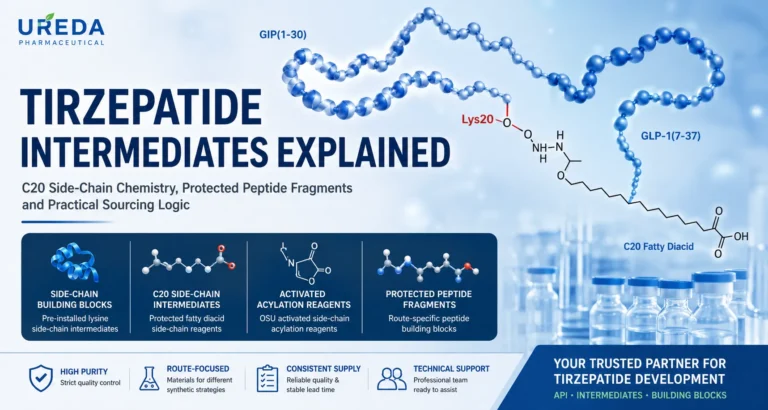
This distinction matters. Tirzepatide is a structurally sophisticated peptide API. FDA documentation describes it as a 39-amino-acid synthetic peptide based on the GIP sequence, containing two Aib residues, a C-terminal amide, and a C20 fatty diacid attached through a linker to Lys20. Its commercial value is tied not only to dual GIP/GLP-1 receptor agonism, but also to the side-chain architecture that supports albumin binding and prolonged exposure.
For this reason, a serious discussion of Tirzepatide intermediates should not begin with a random product list. It should begin with a more practical question:
What role does each intermediate play in a Tirzepatide development strategy?
1. Why Tirzepatide Creates a Distinct Intermediate Supply Chain
Tirzepatide differs from a simpler linear peptide program because its structure creates demand for several chemically distinct classes of intermediates.
At a high level, the molecule combines:
- A long peptide backbone;
- Aib-containing sequence design;
- A linker-bearing lysine modification;
- A C20 fatty diacid side chain that contributes to albumin binding and extended pharmacokinetic behavior.
That combination naturally leads to a more segmented intermediate landscape. Buyers may need:
- A pre-assembled side-chain lysine unit;
- A protected fatty-acid linker intermediate;
- An activated acylating form for side-chain installation;
- A protected peptide fragment for assembly efficiency;
- Supporting upstream building blocks used to construct the final side-chain reagent.
This is why two products can both be marketed as “Tirzepatide intermediates” while serving entirely different synthetic roles.
2. Four Functional Families of Tirzepatide Intermediates
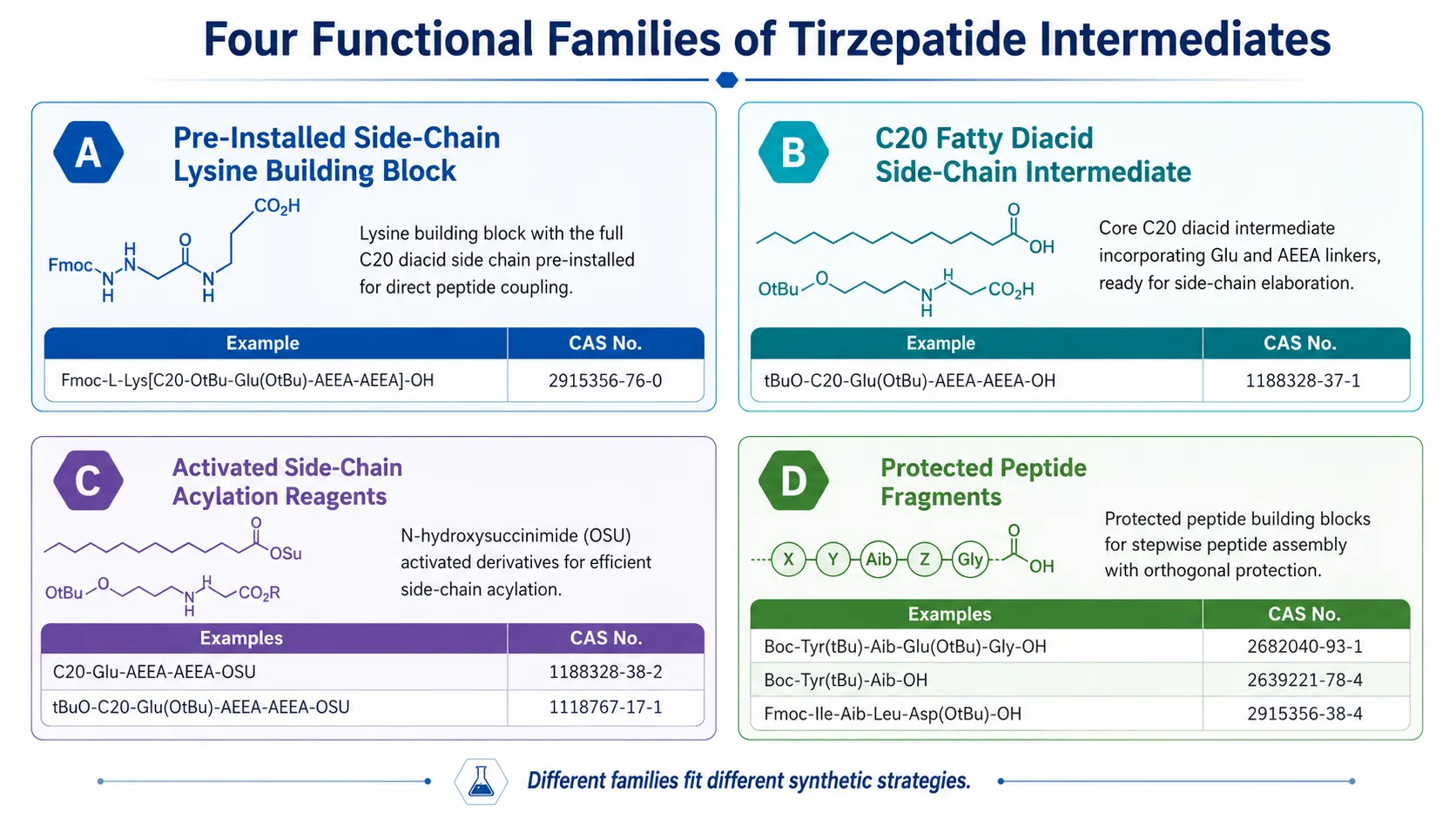
Instead of treating all intermediates as one undifferentiated group, it is more useful to divide them into four practical families.
Family A — Pre-Installed Side-Chain Lysine Building Block
Fmoc-L-Lys[C20-OtBu-Glu(OtBu)-AEEA-AEEA]-OH
CAS No.: 2915356-76-0
This is one of the most recognizable Tirzepatide-related materials in the market. Public patent disclosures on Tirzepatide preparation describe the use of a specialized Fmoc-Lys side-chain building block that incorporates the linker and C20 fatty-acid architecture in a pre-installed form.
Why it matters
This type of intermediate is attractive when a route strategy prefers to:
- Introduce the side-chain architecture as part of a protected lysine residue;
- Simplify downstream side-chain construction steps;
- Reduce the need to separately build and attach the entire linker-fatty-acid unit later in the process.
Practical sourcing logic
A buyer requesting 2915356-76-0 is typically not asking for “a generic Tirzepatide side chain.” They are often looking for a route-defining lysine building block that must match their chosen synthetic sequence, protecting-group system and quality specification.
Family B — C20 Fatty Diacid Side-Chain Intermediates
This family covers the side-chain architecture itself, before or during its activation for peptide attachment.
tBuO-C20-Glu(OtBu)-AEEA-AEEA-OH
CAS No.: 1188328-37-1
This material can be understood as a protected C20 fatty diacid linker intermediate. It includes:
- The C20 lipid element;
- A glutamic acid–based linker segment;
- AEEA-AEEA hydrophilic spacers;
- Protected groups suitable for selected downstream reactions.
Why 1188328-37-1 matters
A customer choosing this intermediate may prefer to:
- Build or activate the side-chain reagent in-house;
- Control the side-chain installation step separately;
- Align the material with a proprietary coupling strategy.
In other words, this product belongs to a different procurement category than 2915356-76-0. The former is a side-chain intermediate; the latter is a pre-installed lysine building block.
Family C — Activated Side-Chain Acylating Reagents
Some projects require not only the C20 side-chain intermediate, but an activated form that can participate more directly in conjugation or coupling chemistry.
C20-Glu-AEEA-AEEA-OSU
CAS No.: 1188328-38-2
tBuO-C20-Glu(OtBu)-AEEA-AEEA-OSU
CAS No.: 1118767-17-1
These materials are best understood as activated side-chain reagents. The OSU/NHS-type activated ester format is valuable in peptide chemistry because it can be used in acylation-oriented approaches where the side chain must be coupled to an amino functionality with controlled reactivity.
Public patent literature on Tirzepatide and related process improvements confirms that its synthetic landscape includes stepwise linear synthesis followed by side-chain coupling, as well as specialized protected building blocks designed to improve synthetic efficiency.
Why this category matters
A procurement team may compare 1188328-37-1, 1188328-38-2 and 1118767-17-1 as if they were interchangeable. They are not.
A more accurate way to understand them is:
| Intermediate | Practical Role |
|---|---|
| 1188328-37-1 | Non-activated protected side-chain intermediate |
| 1188328-38-2 | Activated side-chain acylation format |
| 1118767-17-1 | Protected activated side-chain acylation format |
The route decision depends on how the development team plans to introduce the C20 linker architecture.
Family D — Protected Peptide Fragments for Sequence Assembly
Tirzepatide sourcing is not only about side-chain chemistry. Some buyers are focused on peptide sequence construction, route efficiency and impurity control. For them, protected peptide fragments can be equally important.
Boc-Tyr(tBu)-Aib-Glu(OtBu)-Gly-OH
CAS No.: 2682040-93-1
This protected tetrapeptide fragment is particularly relevant because it appears directly in public patent literature describing a Tirzepatide preparation method designed to improve large-scale purity and process performance.
Representative role
- N-terminal Aib-containing protected peptide fragment;
- Route-relevant material for modular peptide assembly;
- Useful where a process seeks to manage difficult sequence construction through larger protected fragments.
Boc-Tyr(tBu)-Aib-OH
CAS No.: 2639221-78-4
This shorter protected fragment can fit strategies that prefer:
- Smaller, more flexible building blocks;
- Stepwise fragment extension;
- Alternative route optimization scenarios.
Fmoc-Ile-Aib-Leu-Asp(OtBu)-OH
CAS No.: 2915356-38-4
This material belongs to the category of route-specific protected peptide segments. Such fragments are not universally required in every Tirzepatide process, but they can be useful in development programs that rely on modular segment assembly.
A later Tirzepatide process patent notes that newer synthetic strategies continue to explore ways to reduce assembly difficulty, improve product quality and simplify preparation through selected special fragments and optimized synthesis designs.
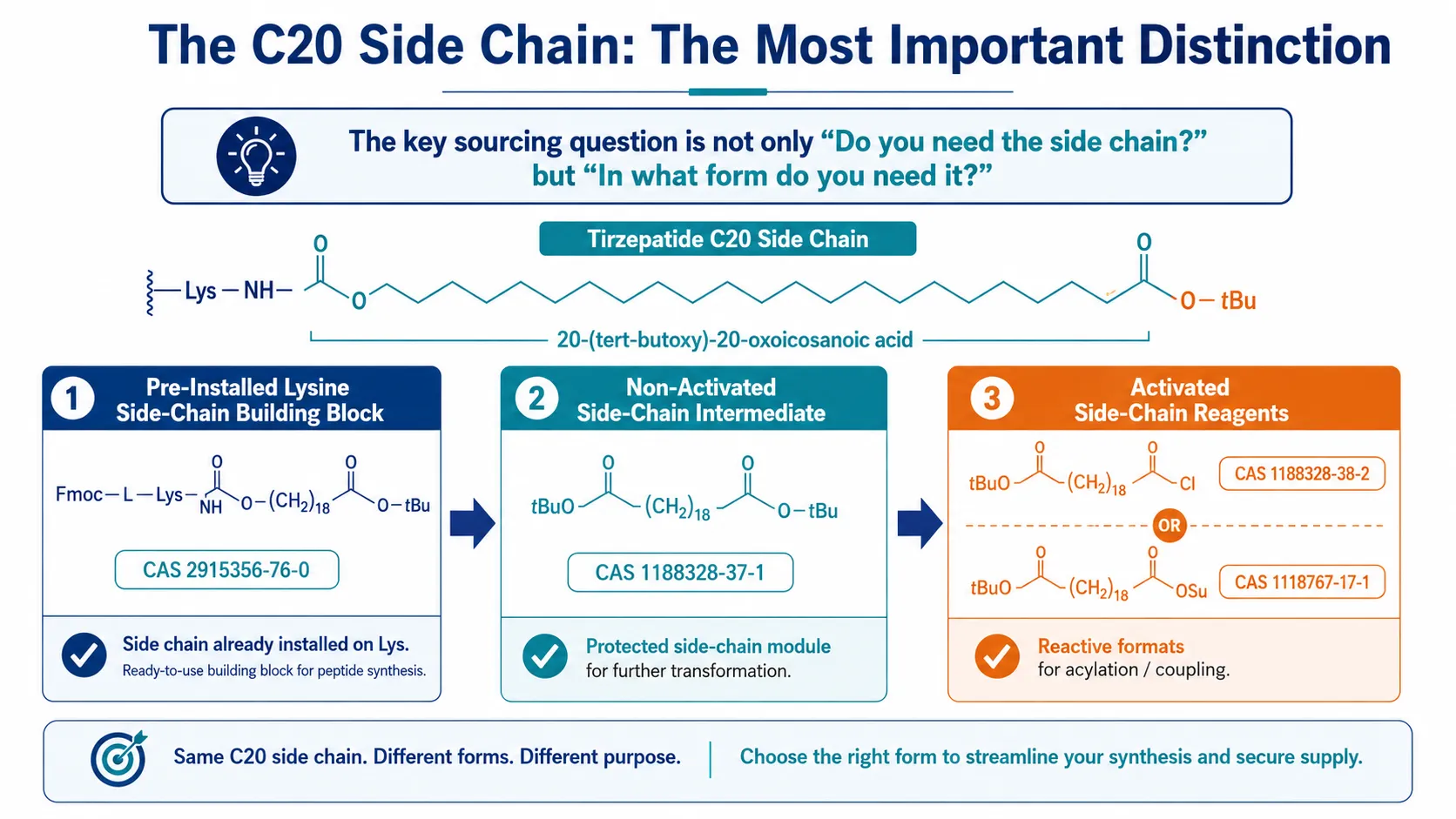
3. The C20 Side Chain: The Most Important Distinction in Tirzepatide Intermediate Procurement
For many pharmaceutical buyers, the most consequential distinction is not “API or intermediate,” but:
What form of the C20 side-chain system is required?
The C20 fatty diacid contributes to Tirzepatide’s albumin binding and long-acting profile. FDA review documents describe the Lys20-linked side-chain structure in detail, including attachment to 1,20-eicosanedioic acid through a linker architecture.
From a sourcing perspective, this gives rise to at least three different material types:
3.1 Pre-Installed Lysine Side Chain
2915356-76-0
This is suitable when the route is designed around a protected lysine residue already carrying the side-chain architecture.
3.2 Non-Activated Side-Chain Intermediate
1188328-37-1
This is relevant when the buyer wants the side-chain module itself, with further activation or transformation to be handled according to the selected process.
3.3 Activated Side-Chain Reagent
1188328-38-2
1118767-17-1
These are relevant when the route requires a more reactive acylating side-chain format for controlled coupling.
Why this distinction matters
If a buyer asks for “Tirzepatide side chain,” a capable supplier should not immediately quote a product without clarification. A technically meaningful response should first identify whether the buyer needs:
- A lysine-installed side-chain building block;
- A protected side-chain intermediate;
- An activated side-chain acylating reagent.
This simple clarification can prevent costly mismatches in early-stage sourcing.
4. Three Buyer Scenarios: Which Tirzepatide Intermediate Does a Project Actually Need?
This section reflects how Tirzepatide intermediate requests often appear in real pharmaceutical communication.
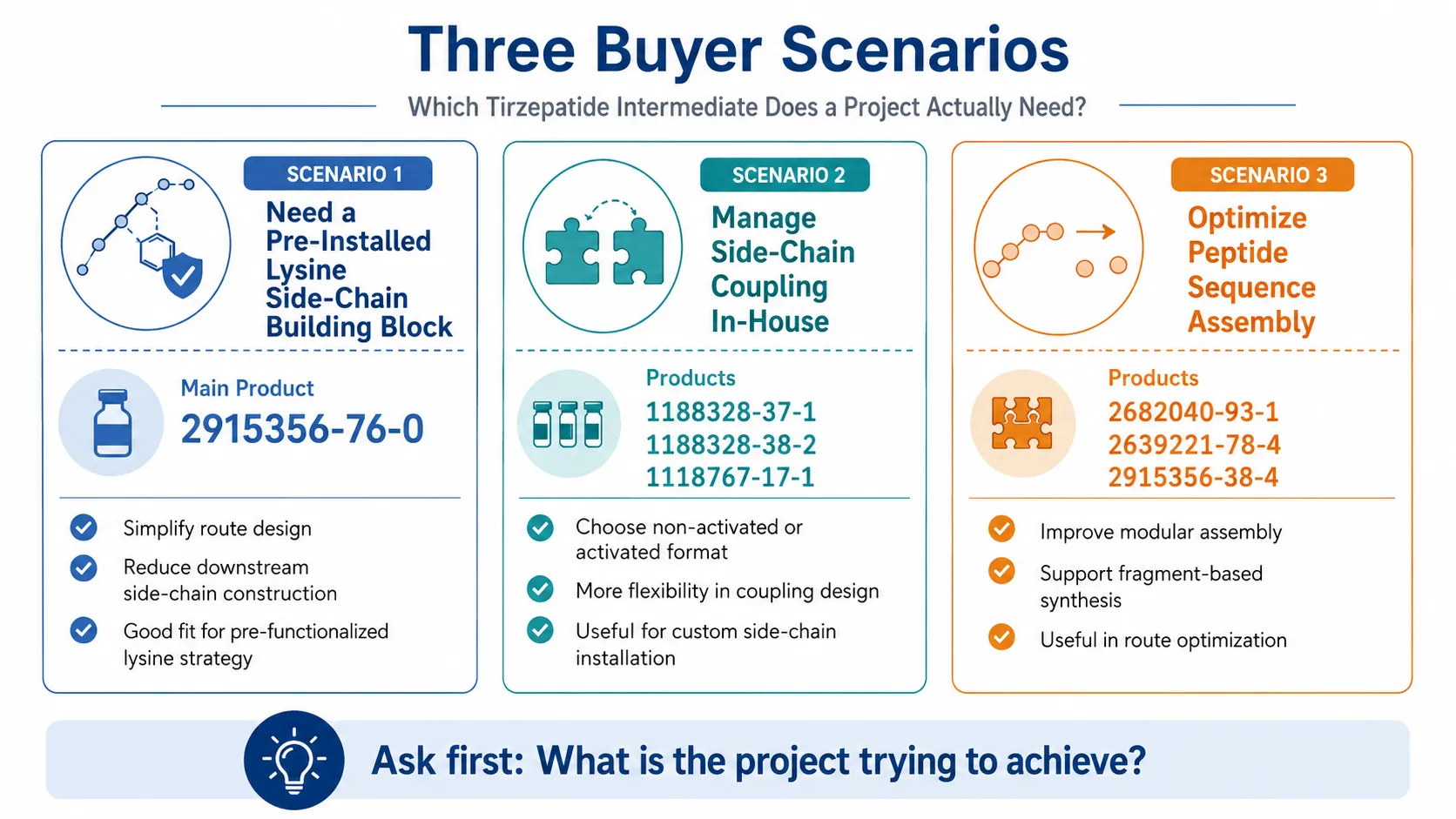
Scenario 1: “We need the Tirzepatide side-chain lysine building block.”
Most likely material:
Fmoc-L-Lys[C20-OtBu-Glu(OtBu)-AEEA-AEEA]-OH
CAS No.: 2915356-76-0
What the buyer is usually trying to achieve:
- Incorporate the full side-chain architecture during peptide assembly;
- Reduce downstream modular construction complexity;
- Align the material with a route using a pre-functionalized lysine building block.
Scenario 2: “We want to manage side-chain coupling ourselves.”
Likely materials:
- 1188328-37-1
- 1188328-38-2
- 1118767-17-1
What the buyer is usually comparing:
- Protected but non-activated side-chain intermediate;
- Activated OSU-type format;
- Protected activated reagent suitable for a chosen coupling system.
Scenario 3: “We are optimizing peptide sequence assembly, not only side-chain installation.”
Likely materials:
- 2682040-93-1
- 2639221-78-4
- 2915356-38-4
What the buyer is usually concerned about:
- Difficult sequence regions;
- Assembly efficiency;
- Fragment condensation or modular route design;
- Protection compatibility;
- Purity and impurity behavior during scale-up.
5. Common Confusions in the Tirzepatide Intermediate Market
A practical article on Tirzepatide should address not only what the products are, but also what buyers often confuse.
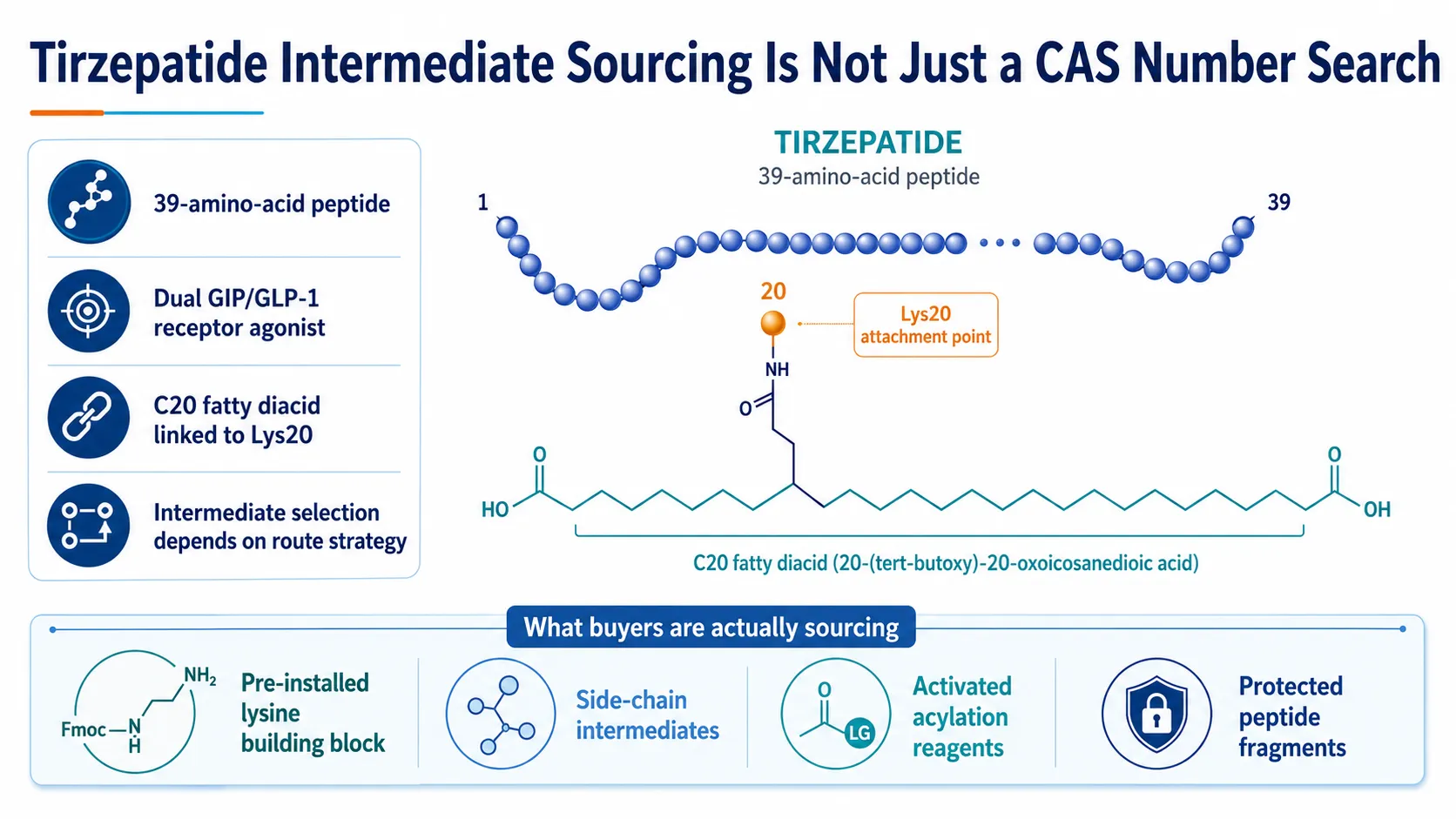
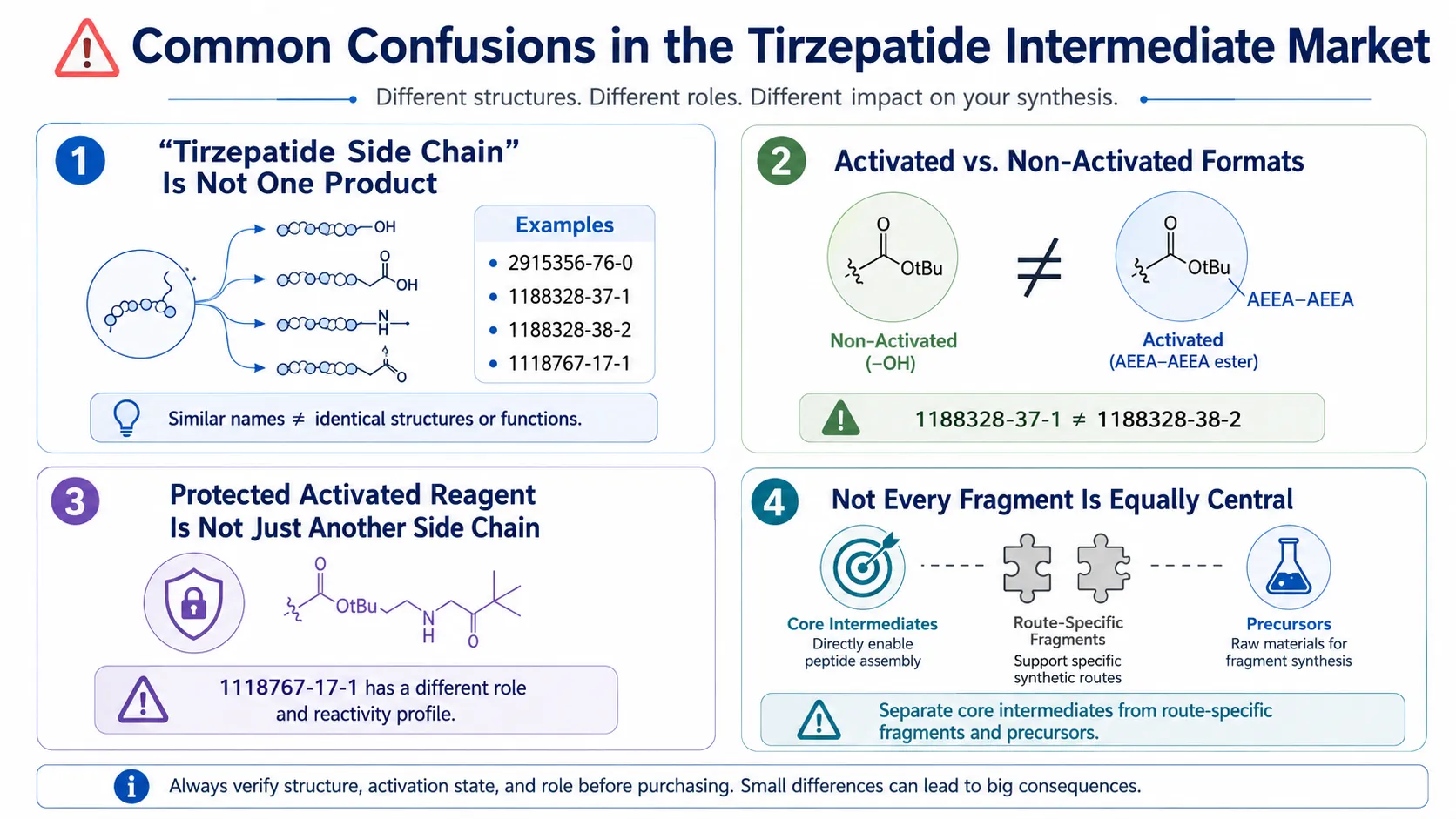
Confusion 1: “Tirzepatide side chain” does not refer to only one product
Depending on route design, “side chain” may refer to:
- 2915356-76-0 — side-chain already installed on lysine;
- 1188328-37-1 — protected side-chain intermediate;
- 1188328-38-2 — activated side-chain format;
- 1118767-17-1 — protected activated side-chain format.
A supplier who does not distinguish these may create confusion during quotation and qualification.
Confusion 2: Activated and non-activated intermediates are not interchangeable
1188328-37-1 and 1188328-38-2 belong to related side-chain chemistry, but their functions are different. One is a protected side-chain intermediate; the other is designed for activated acylation-oriented use. The correct choice depends on the buyer’s synthetic plan.
Confusion 3: A “Tirzepatide intermediate” may be chemically related, but not commercially central
Some smaller peptide fragments or upstream materials may appear in route-development discussions, but they are not always the most requested or most commercially recognizable items. For a professional product portfolio, it is useful to separate:
- Core intermediates;
- Route-specific peptide fragments;
- Supporting upstream building blocks.
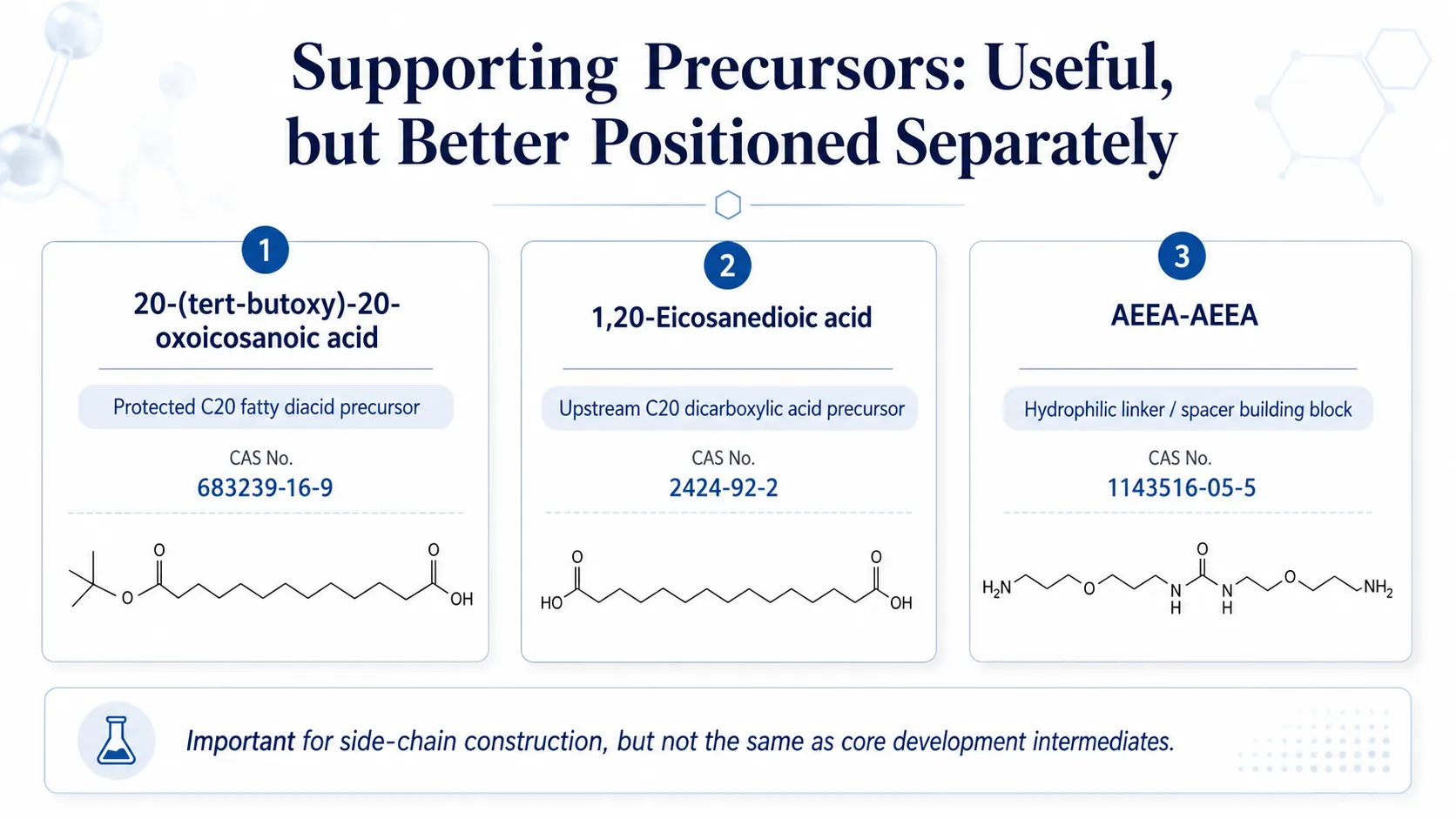
6. Supporting Precursors: Useful, but Better Positioned Separately
In addition to the core intermediates, several related materials can support the construction of the Tirzepatide side-chain system.
| Product Name | CAS No. | Role in the Supply Chain |
|---|---|---|
| 20-(tert-butoxy)-20-oxoicosanoic acid | 683239-16-9 | Protected C20 fatty diacid precursor |
| 1,20-Eicosanedioic acid | 2424-92-2 | Upstream C20 dicarboxylic acid precursor |
| AEEA-AEEA | 1143516-05-5 | Hydrophilic linker / spacer building block |
These materials are important, but they should not be presented as if they serve the same route role as a protected lysine side-chain building block or a major peptide fragment. A clear portfolio separates core development intermediates from supporting precursors.
7. What a Technical Buyer Should Verify Before Purchasing Tirzepatide Intermediates
For high-value peptide development, the lowest quotation is rarely the only issue. A more meaningful supplier review should focus on whether the material truly fits the project.
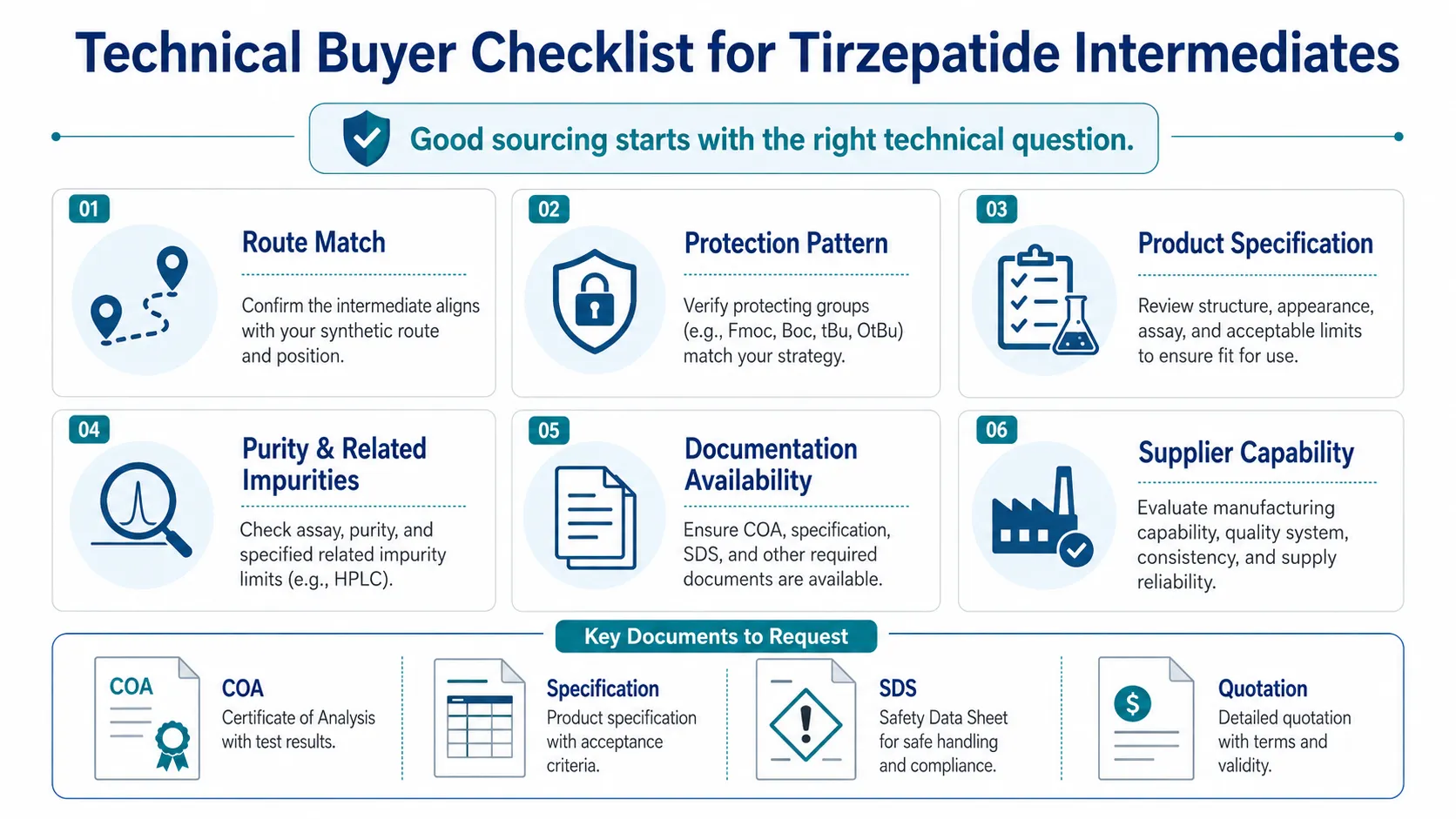
7.1 Does the Material Match the Intended Route Logic?
A buyer should first determine whether they need:
- A pre-installed lysine side-chain unit;
- A non-activated side-chain precursor;
- An activated side-chain reagent;
- A protected peptide fragment;
- An upstream precursor only.
7.2 Is the Protection Pattern Clearly Defined?
For materials such as:
- 2915356-76-0
- 2682040-93-1
- 2639221-78-4
- 1118767-17-1
the protection system is part of the product’s identity. It should not be treated as a secondary detail.
7.3 Is the Product Specification Route-Relevant?
For Tirzepatide intermediates, a useful specification may need to consider:
- Chemical identity;
- Purity;
- Related impurities;
- Residual solvents;
- Moisture or storage sensitivity;
- For activated formats, stability and reactivity-related handling expectations.
7.4 Can the Supplier Explain the Product’s Role?
A qualified supplier should be able to distinguish:
- “This is a pre-installed lysine side-chain building block”
- “This is an activated side-chain reagent”
- “This is a protected N-terminal peptide fragment”
- “This is an upstream fatty-acid precursor”
That technical clarity matters more than simply repeating a CAS number.
8. Ureda’s Selected Tirzepatide Portfolio
To support different Tirzepatide development and sourcing strategies, Huzhou Ureda Pharmaceutical Co., Ltd. organizes its selected portfolio into three practical layers.
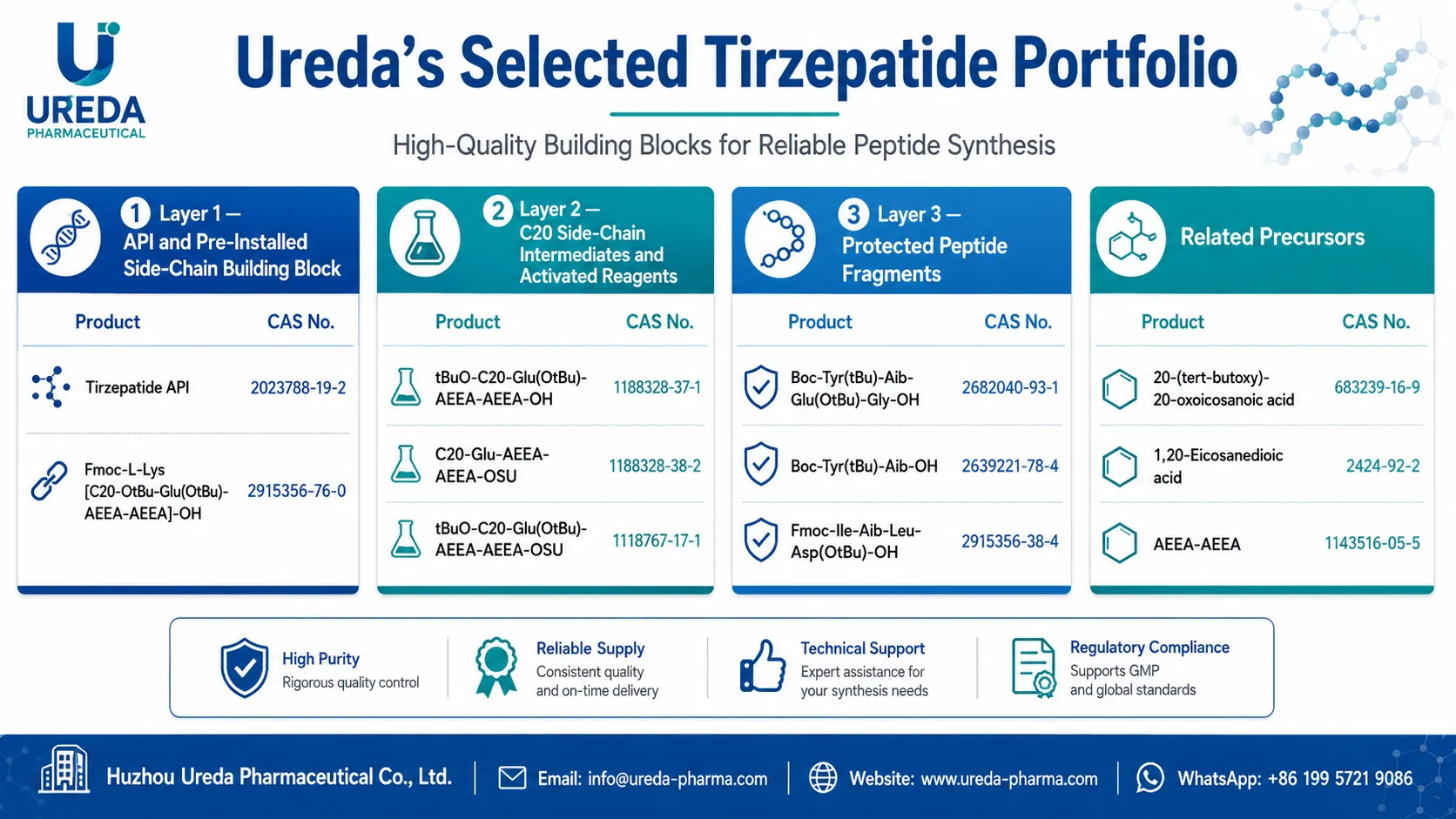
Layer 1 — API and Pre-Installed Side-Chain Building Block
| Product Name | CAS No. |
|---|---|
| Tirzepatide API | 2023788-19-2 |
| Fmoc-L-Lys[C20-OtBu-Glu(OtBu)-AEEA-AEEA]-OH | 2915356-76-0 |
Layer 2 — C20 Side-Chain Intermediates and Activated Reagents
| Product Name | CAS No. |
|---|---|
| tBuO-C20-Glu(OtBu)-AEEA-AEEA-OH | 1188328-37-1 |
| C20-Glu-AEEA-AEEA-OSU | 1188328-38-2 |
| tBuO-C20-Glu(OtBu)-AEEA-AEEA-OSU | 1118767-17-1 |
Layer 3 — Protected Peptide Fragments and Route-Specific Segments
| Product Name | CAS No. |
|---|---|
| Boc-Tyr(tBu)-Aib-Glu(OtBu)-Gly-OH | 2682040-93-1 |
| Boc-Tyr(tBu)-Aib-OH | 2639221-78-4 |
| Fmoc-Ile-Aib-Leu-Asp(OtBu)-OH | 2915356-38-4 |
Related Precursors
| Product Name | CAS No. |
|---|---|
| 20-(tert-butoxy)-20-oxoicosanoic acid | 683239-16-9 |
| 1,20-Eicosanedioic acid | 2424-92-2 |
| AEEA-AEEA | 1143516-05-5 |
Available Support
For qualified pharmaceutical development inquiries, Ureda can support discussion of:
- Product specifications;
- COA availability where appropriate;
- Packing and storage information;
- Sample inquiry coordination;
- Quotation support;
- Clarification of the product’s route role and intermediate category.
9. Frequently Asked Questions
FAQ 1: What is the most recognizable Tirzepatide side-chain building block?
A widely recognized material is:
Fmoc-L-Lys[C20-OtBu-Glu(OtBu)-AEEA-AEEA]-OH
CAS No.: 2915356-76-0
It is relevant when the development strategy uses a pre-installed protected lysine side-chain building block.
FAQ 2: Are 1188328-37-1 and 1188328-38-2 the same type of intermediate?
No. They are related to the same C20 side-chain architecture, but they serve different synthetic roles.
1188328-37-1 is a protected non-activated side-chain intermediate, while 1188328-38-2 is an activated side-chain format.
FAQ 3: Why are Boc-Tyr(tBu)-Aib-Glu(OtBu)-Gly-OH and Boc-Tyr(tBu)-Aib-OH relevant?
They are protected Aib-containing peptide fragments that may support different Tirzepatide peptide assembly strategies. Public patent literature specifically describes the use of specialized protected amino-acid or peptide materials to improve Tirzepatide synthesis approaches.
FAQ 4: Does every Tirzepatide project require the same intermediates?
No. The exact intermediate requirement depends on the buyer’s route design, side-chain installation strategy, protection system and stage of development.
FAQ 5: What information should buyers provide when requesting a Tirzepatide intermediate quotation?
To improve quotation accuracy, buyers should ideally specify:
- Product name and CAS number;
- Required quantity;
- Intended development stage;
- Whether they need API, side-chain reagent or peptide fragment;
- Any preferred specification or documentation requirements.
Conclusion: Good Tirzepatide Sourcing Starts with the Right Technical Question
Tirzepatide has created a highly specialized intermediate landscape. Its dual GIP/GLP-1 biology attracts market attention, but from a pharmaceutical manufacturing perspective, its C20 fatty diacid side-chain architecture and route-dependent intermediate selection are what make procurement technically interesting.
A meaningful Tirzepatide intermediate discussion should not stop at:
“Do you have this CAS number?”
It should continue with:
- Is this material a pre-installed lysine side-chain building block?
- Is it an activated or non-activated C20 side-chain reagent?
- Is it a protected peptide fragment?
- Does it match the buyer’s route logic and protection strategy?
Suppliers who can answer those questions clearly are far more useful to pharmaceutical customers than suppliers who only forward a price list.
Contact CTA
Looking for Tirzepatide API or Route-Relevant Intermediates?
Huzhou Ureda Pharmaceutical Co., Ltd. supports selected Tirzepatide APIs, C20 side-chain intermediates, protected lysine building blocks and peptide fragments for pharmaceutical development projects.
For quotation, product specification, COA availability or technical inquiry, please contact:
Huzhou Ureda Pharmaceutical Co., Ltd.
Email: sales@uredapharm.com
Website: www.uredapharm.com
WhatsApp: +86-13867276965