Introduction: Retatrutide Is Not Merely “Another GLP-1 Molecule”
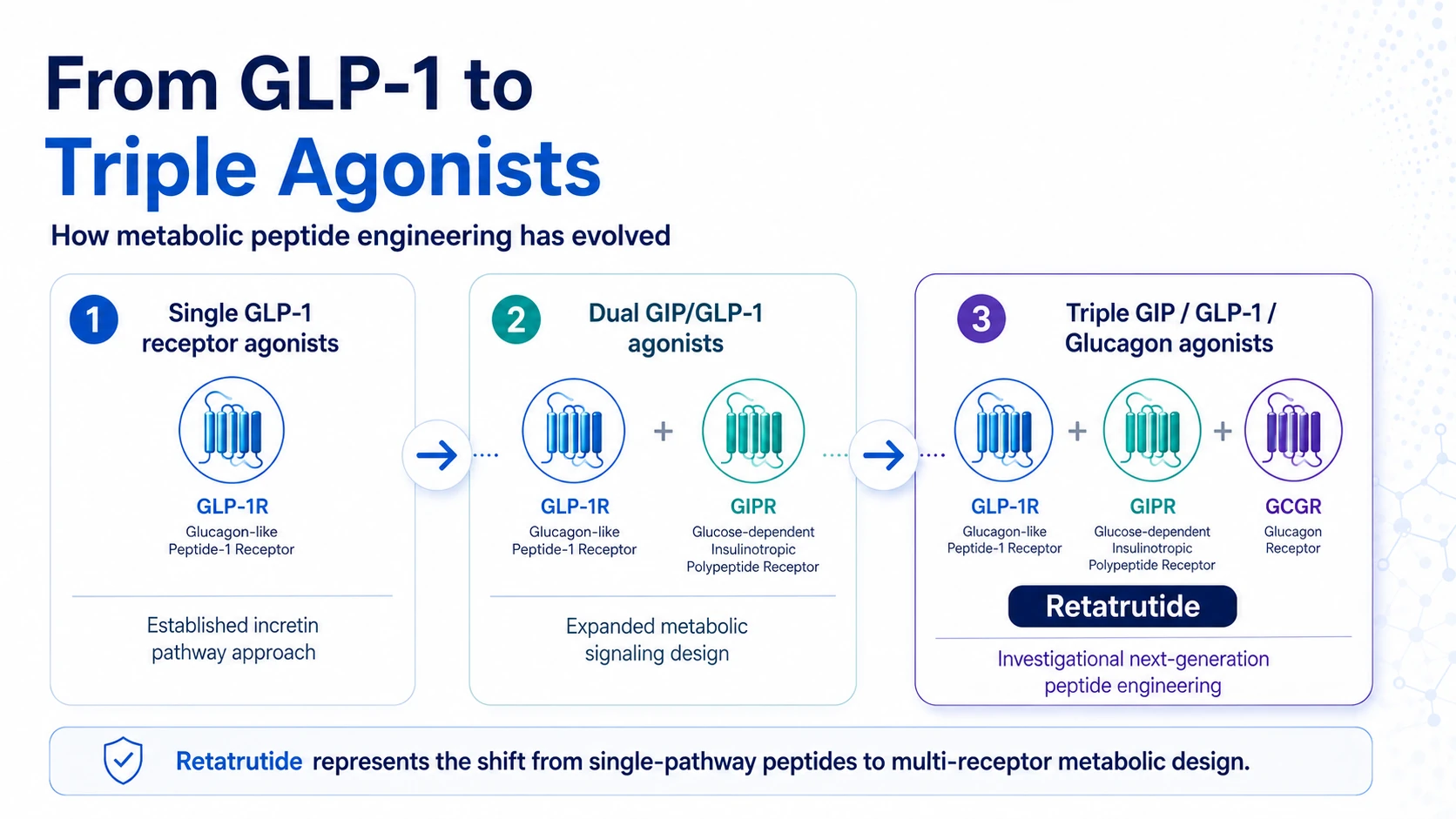
The metabolic peptide field has evolved rapidly. The industry first saw major commercial momentum around single-pathway GLP-1 receptor agonists, followed by increasing attention to dual GIP/GLP-1 receptor agonists. Retatrutide represents a further step forward: an investigational triple hormone receptor agonist designed to activate the receptors for GIP, GLP-1 and glucagon within a single molecular framework. Eli Lilly continues to describe Retatrutide as an investigational once-weekly compound in clinical development, not an approved medicine.
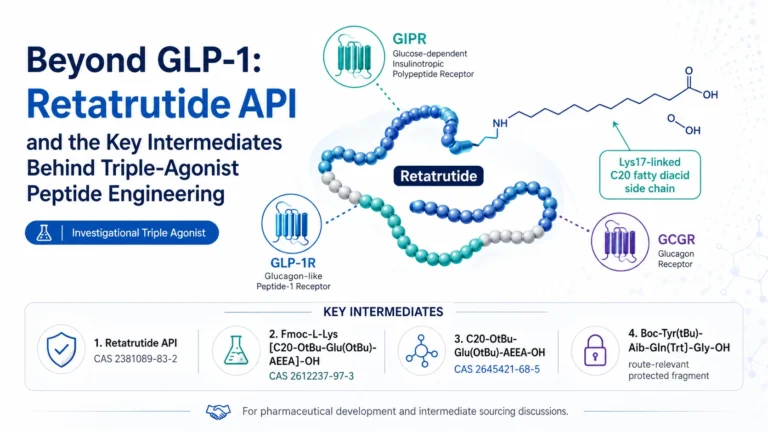
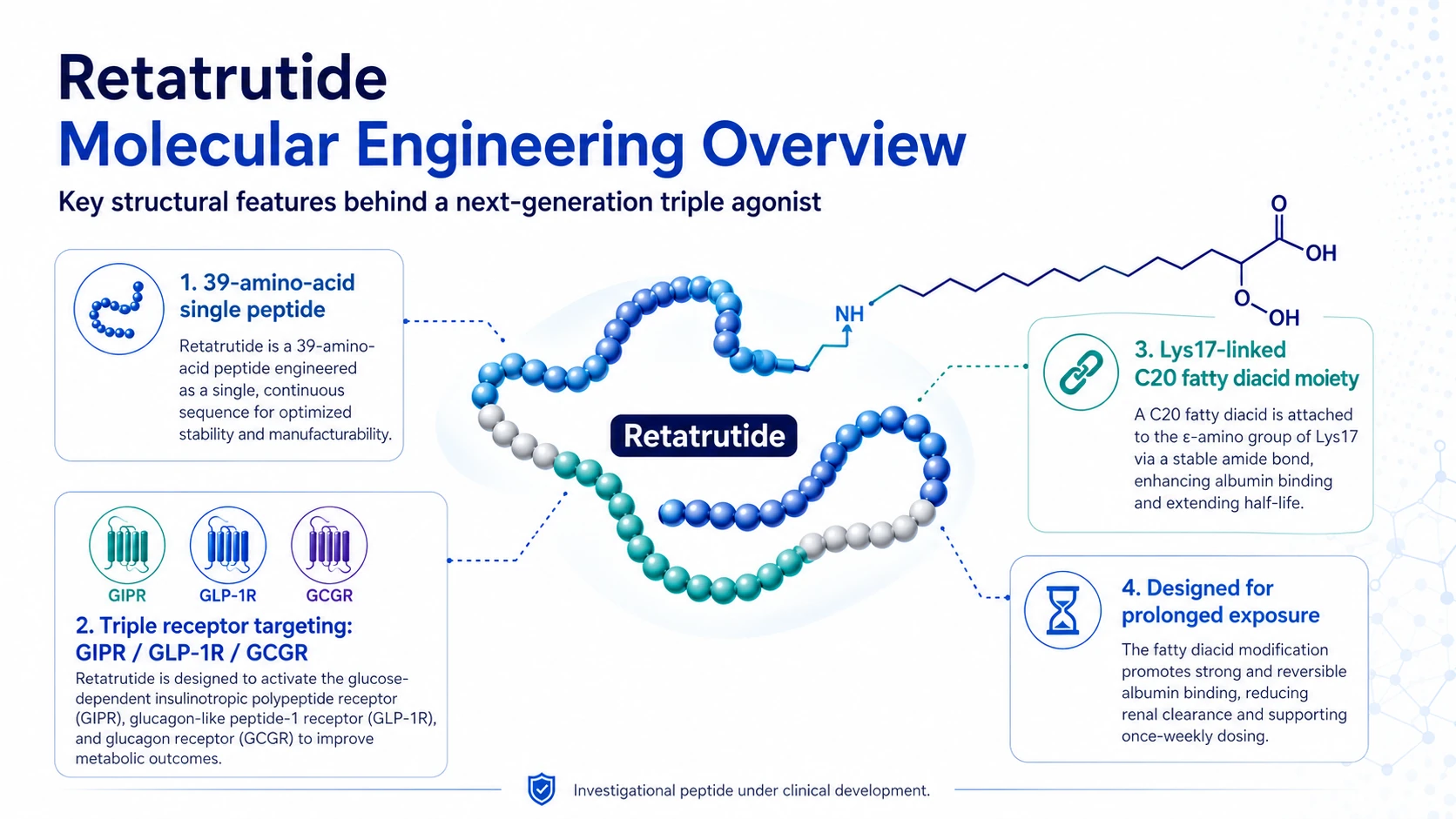
For pharmaceutical researchers, peptide manufacturers and sourcing teams, Retatrutide is important for a second reason: its value is not defined only by the final peptide sequence. It is also shaped by a deliberate molecular engineering strategy, including a long peptide backbone, receptor-balancing design and a C20 fatty diacid side chain attached through a linker at Lys17. Public scientific literature describes LY3437943/Retatrutide as a 39-amino-acid single peptide carrying this lipidic modification, which contributes to its long-acting profile.
This creates a focused but highly specialized intermediate landscape. Rather than requiring an oversized list of loosely related compounds, Retatrutide development places particular value on a small number of strategically important materials:
- C20 fatty diacid side-chain building blocks
- Pre-functionalized lysine side-chain intermediates
- Protected peptide fragments that support efficient sequence assembly
This article examines those materials from a pharmaceutical development and sourcing perspective.
1. Retatrutide and the Shift Toward Triple-Receptor Peptide Engineering
Retatrutide, also known as LY3437943, was reported as a novel peptide capable of engaging three metabolic receptors:
- Glucagon receptor (GCGR)
- Glucose-dependent insulinotropic polypeptide receptor (GIPR)
- Glucagon-like peptide-1 receptor (GLP-1R)
The original discovery work in Cell Metabolism described LY3437943 as a triple agonist peptide developed for improved glycemic control and weight-management potential, while subsequent clinical studies supported continued investigation in metabolic disease.
From a chemistry and process perspective, this triple-receptor positioning matters because it signals that Retatrutide is not simply a minor modification of an earlier GLP-1 peptide. It belongs to a more advanced generation of multi-hormonal peptide design, where potency balance, sequence engineering and pharmacokinetic extension must be addressed simultaneously.
The molecule therefore presents a different intermediate-sourcing profile from more established GLP-1 peptides. Instead of treating “Retatrutide intermediates” as a generic category, a technically sound supplier should understand which intermediates directly support:
- The Lys17-linked side-chain architecture
- The long-acting fatty diacid design
- The protected N-terminal and internal peptide-fragment strategy
2. The Structural Feature That Matters Most: Lys17-Linked C20 Fatty Diacid Modification
Retatrutide’s distinctive architecture includes a C20 fatty diacid moiety linked through a spacer to the Lys17 residue. Public literature describing LY3437943 identifies this conjugation as part of the molecule’s long-acting design.
This structural feature is significant for two reasons.
First, it links Retatrutide to the broader strategy of lipidated long-acting peptide engineering, in which fatty acid motifs are used to influence albumin binding and pharmacokinetic behavior.
Second, it creates direct commercial relevance for specialized intermediates that are not interchangeable with ordinary amino acid derivatives. When buyers ask for a “Retatrutide side chain,” they may actually be referring to different material classes depending on their synthetic route:
- A pre-installed lysine side-chain building block
- A C20 fatty acid–linker intermediate
- A protected fragment used in sequence assembly
The supplier’s ability to distinguish these materials is a meaningful indicator of technical competence.
3. Retatrutide Side-Chain Engineering: Two Intermediates That Matter Most
Among publicly identifiable Retatrutide-related materials, two side-chain intermediates stand out as especially important.
3.1 Fmoc-L-Lys[C20-OtBu-Glu(OtBu)-AEEA]-OH
CAS No.: 2612237-97-3
A public Retatrutide preparation patent explicitly identifies the Retatrutide side chain as CAS 2612237-97-3. The same patent describes a protected peptide resin incorporating a Lys residue bearing an AEEA-γGlu-Eicosanedioic acid side-chain architecture.
This makes 2612237-97-3 one of the most strategically recognizable Retatrutide-related intermediates.
Why this intermediate is important
This material is valuable because it integrates several high-value design elements into a single protected lysine building block:
- Protected lysine
- AEEA spacer
- γ-Glu linker
- C20 fatty diacid-derived lipid segment
For a development team, this can serve as a route-defining intermediate, especially when the synthetic strategy is built around installing a pre-functionalized lysine residue rather than constructing the full side-chain architecture later.
What a buyer is usually looking for
A customer asking for 2612237-97-3 is typically not requesting a generic fatty acid reagent. They are more often seeking a highly route-specific Retatrutide side-chain lysine intermediate that must match their peptide synthesis strategy, protection system and analytical expectations.
3.2 C20-OtBu-Glu(OtBu)-AEEA-OH
CAS No.: 2645421-68-5
A separate publicly disclosed Retatrutide preparation method describes selective side-chain modification after deprotection of the relevant lysine site and uses a Retatrutide side-chain material listed as CAS 2645421-68-5.
This material represents a different point in the synthetic logic from 2612237-97-3.
Why this intermediate is important
Whereas 2612237-97-3 is a more integrated pre-installed lysine side-chain building block, 2645421-68-5 is better understood as a C20 fatty-acid side-chain intermediate used in a route that handles side-chain attachment as a separate step.
Practical sourcing distinction
| Intermediate | Practical Interpretation |
|---|---|
| 2612237-97-3 | Pre-functionalized lysine side-chain building block |
| 2645421-68-5 | Side-chain coupling material for a route with separate side-chain installation |
This distinction is commercially important. A buyer sourcing the wrong intermediate may end up with a material that is chemically relevant to Retatrutide but unsuitable for the specific synthetic sequence being developed.
4. Retatrutide Is Also a Fragment-Engineering Story
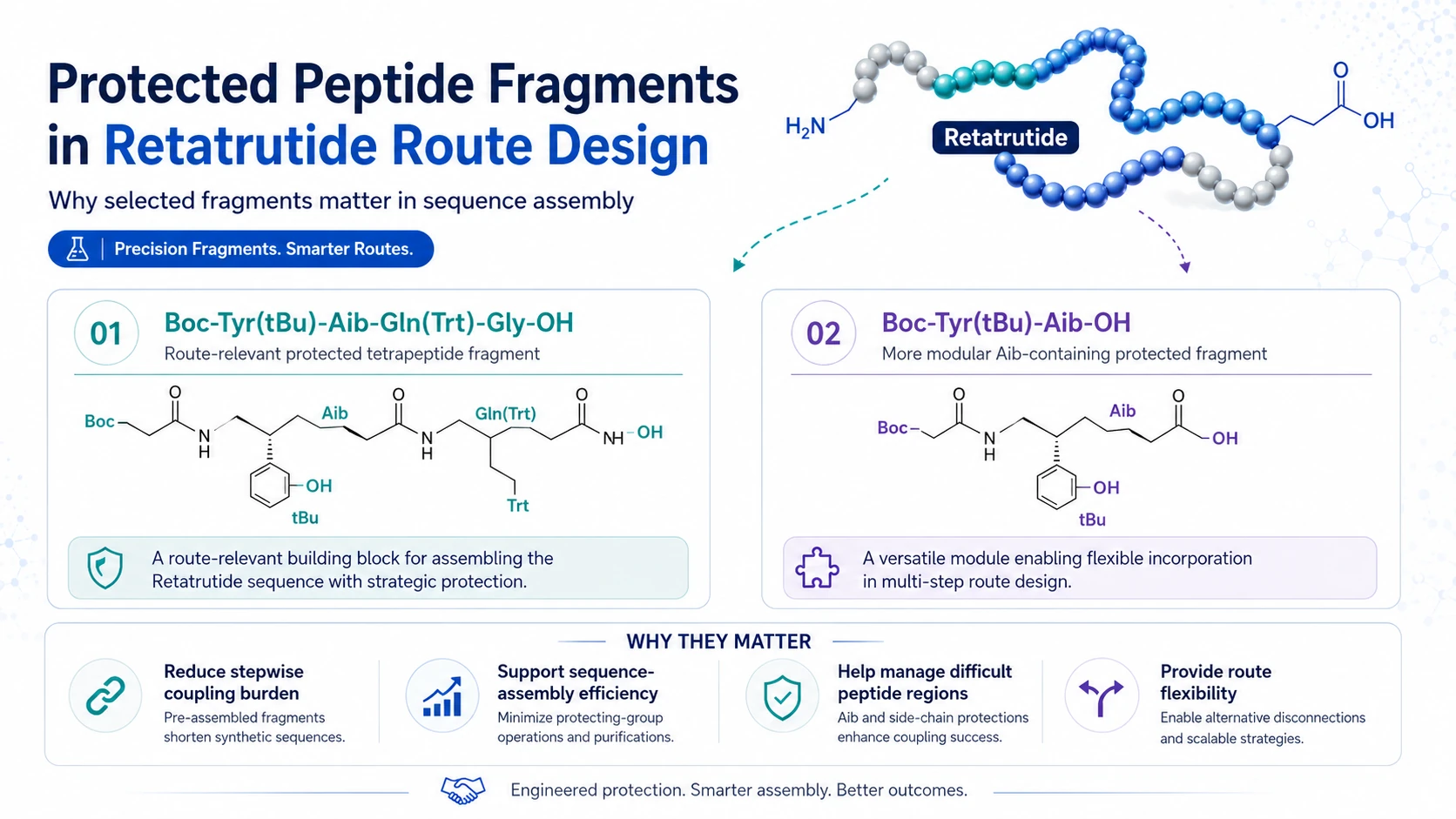
The side-chain system is central, but it is not the only part of the Retatrutide synthesis challenge. Public patent literature indicates that protected peptide fragments can be used to improve route efficiency, reduce the burden of stepwise assembly and improve crude-peptide quality.
This is particularly relevant for a long peptide such as Retatrutide, where repeated couplings over many residues may raise concerns around:
- Coupling efficiency
- Deletion sequences
- Accumulation of synthesis-related impurities
- Time and cost in a long linear assembly
Patent disclosures describe protected fragments such as:
- Boc-Tyr(tBu)-Aib-Gln(Trt)-Gly-OH
- Boc-Tyr(tBu)-Aib-OH
as components of selected Retatrutide synthetic strategies.
![Comparison of two important Retatrutide side-chain intermediates, Fmoc-L-Lys[C20-OtBu-Glu(OtBu)-AEEA]-OH with CAS 2612237-97-3 and C20-OtBu-Glu(OtBu)-AEEA-OH with CAS 2645421-68-5.](https://uredapharm.com/wp-content/uploads/2026/05/04-retatrutide-side-chain-intermediates-comparison.webp)
4.1 Boc-Tyr(tBu)-Aib-Gln(Trt)-Gly-OH
One public patent specifically describes a Retatrutide preparation approach using the protected N-terminal fragment Boc-Tyr(tBu)-Aib-Gln(Trt)-Gly-OH. The same patent suggests that protected peptide-fragment strategies can reduce the number of coupling operations, shorten the synthesis period and improve certain production metrics.
Why it matters
This fragment is not just an arbitrary short peptide. It corresponds to a route-relevant N-terminal segment and reflects a broader design principle:
In advanced peptide manufacturing, a carefully chosen protected fragment may be more valuable than a larger list of generic amino-acid derivatives.
4.2 Boc-Tyr(tBu)-Aib-OH
Another disclosed Retatrutide synthesis patent describes the introduction of Boc-Tyr(tBu)-Aib-OH as part of a sequence-assembly strategy intended to reduce deletion peptide and racemization-related risks associated with long reaction times.
Why it matters
This smaller fragment is more modular than the longer tetrapeptide described above. It may be relevant in synthetic programs that prefer:
- Shorter protected building blocks
- More flexible route adaptation
- Alternative assembly sequencing
The key point is that these fragments should be positioned as route-relevant peptide fragments, not as generic Retatrutide “side chains.”
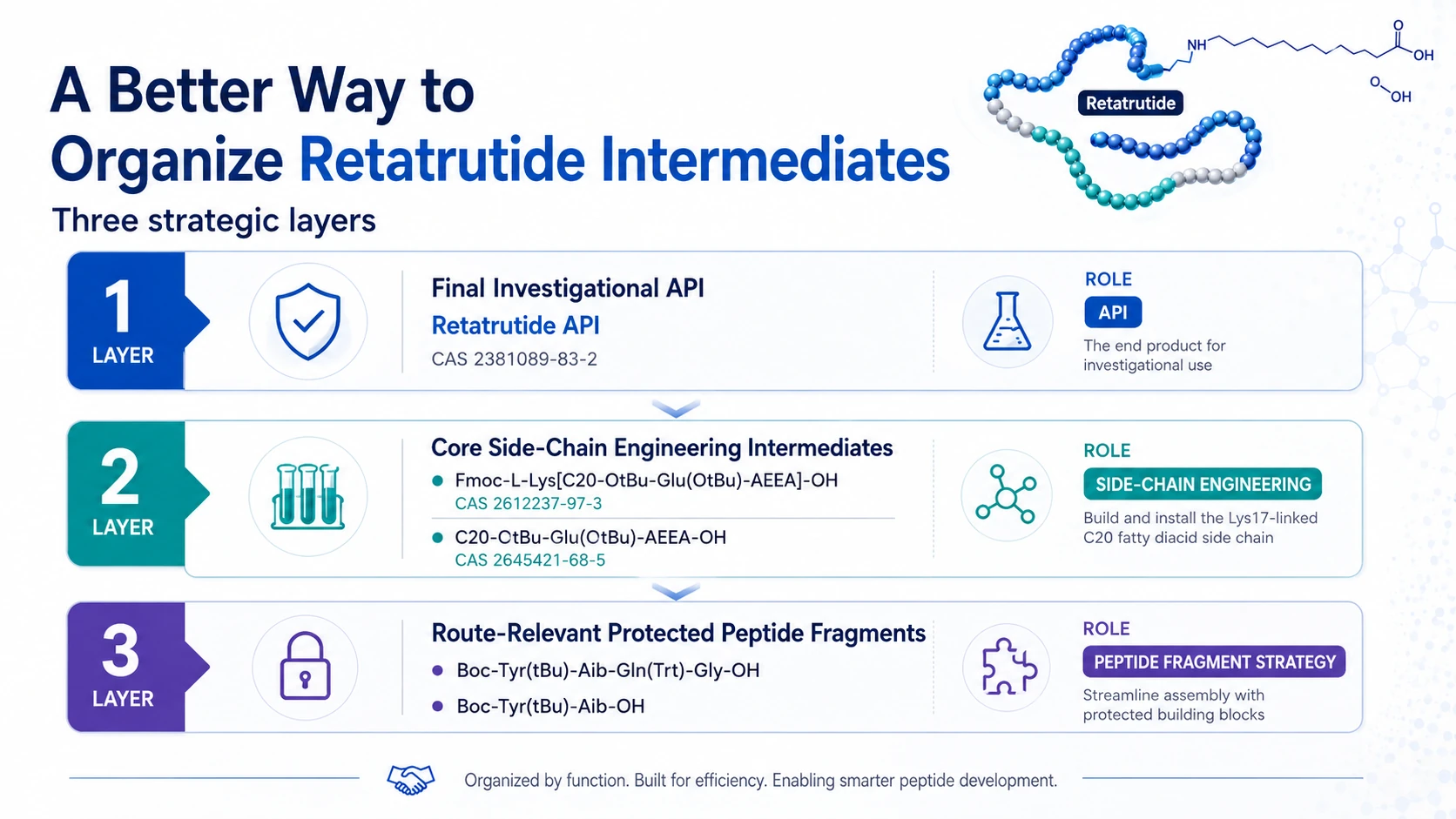
5. A Better Way to Organize Retatrutide Intermediates
Many market-facing product lists simply place all Retatrutide-related compounds under one heading. A more professional approach is to organize them by functional relevance.
Layer 1 — Final Investigational API
| Product | CAS No. | Positioning |
|---|---|---|
| Retatrutide API | 2381089-83-2 | Investigational triple GIP/GLP-1/glucagon agonist peptide |
Retatrutide remains under clinical development and is not an approved commercial medicine.
Layer 2 — Core Side-Chain Engineering Intermediates
| Product | CAS No. | Positioning |
|---|---|---|
| Fmoc-L-Lys[C20-OtBu-Glu(OtBu)-AEEA]-OH | 2612237-97-3 | Pre-functionalized lysine side-chain building block |
| C20-OtBu-Glu(OtBu)-AEEA-OH | 2645421-68-5 | C20 fatty-acid side-chain coupling material |
These two materials are the most directly relevant publicly traceable intermediates for Retatrutide side-chain engineering.
Layer 3 — Route-Relevant Protected Peptide Fragments
| Product | Role |
|---|---|
| Boc-Tyr(tBu)-Aib-Gln(Trt)-Gly-OH | Protected N-terminal fragment described in Retatrutide patent literature |
| Boc-Tyr(tBu)-Aib-OH | Shorter Aib-containing protected fragment described in alternative route design |
Both appear in public Retatrutide synthesis disclosures, but their use depends on the selected process design.
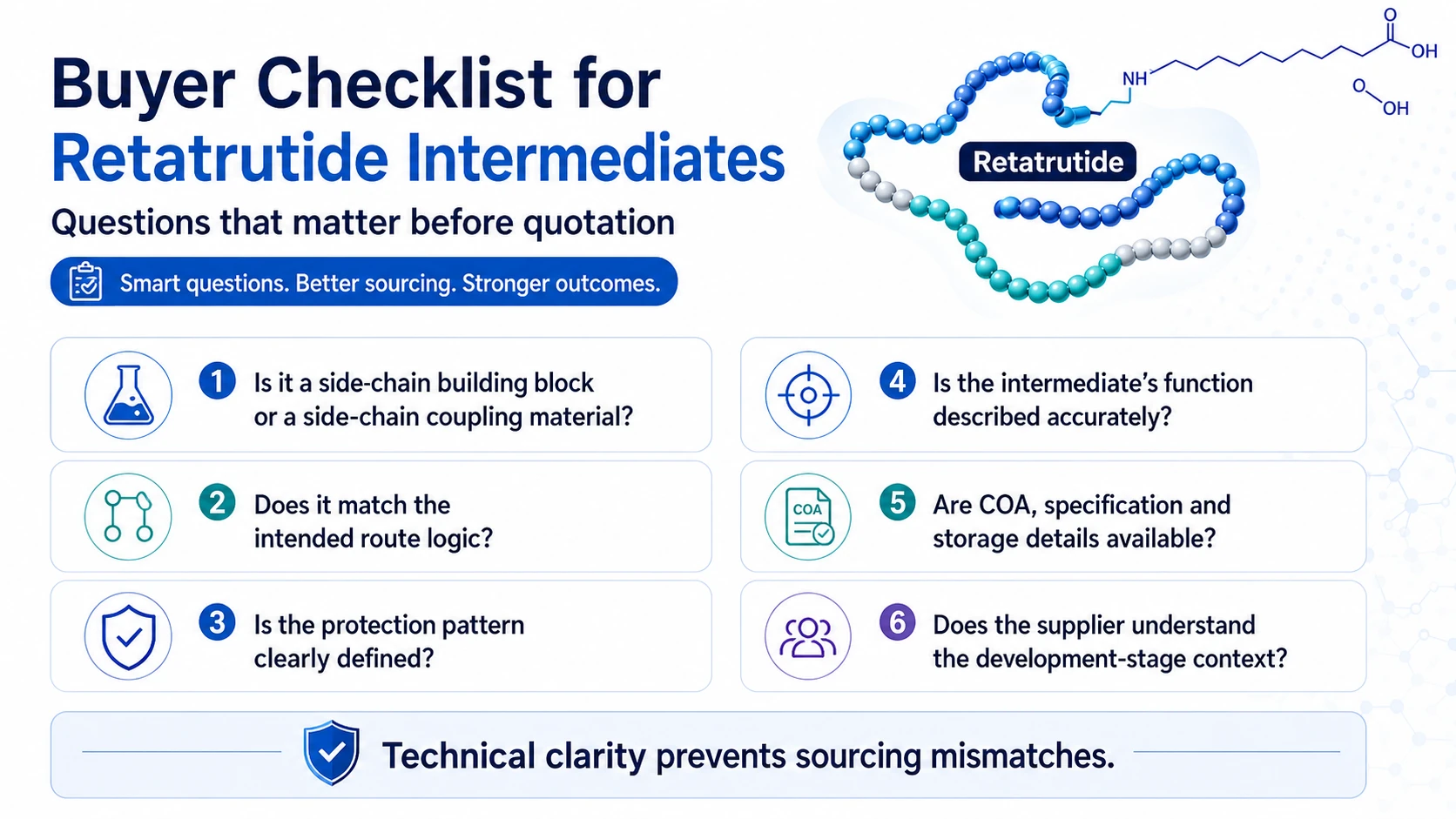
6. What Pharmaceutical Buyers Should Clarify Before Sourcing Retatrutide Intermediates
Because Retatrutide-related materials can serve different synthetic roles, a technically informed sourcing discussion should clarify several points before quotation.
6.1 Is the Buyer Seeking a Side-Chain Building Block or a Side-Chain Coupling Material?
This is the first and most important question.
- 2612237-97-3 is a pre-functionalized lysine side-chain building block.
- 2645421-68-5 belongs to a side-chain coupling strategy handled separately during the synthetic sequence.
These are related, but they are not interchangeable.
6.2 Does the Route Use Protected Peptide Fragments?
If the buyer is optimizing sequence assembly rather than side-chain chemistry, the discussion may shift toward protected fragments such as:
- Boc-Tyr(tBu)-Aib-Gln(Trt)-Gly-OH
- Boc-Tyr(tBu)-Aib-OH
Public patent literature shows that such fragments may be introduced specifically to address synthesis efficiency and impurity-related challenges in Retatrutide preparation.
6.3 Is the Supplier Describing the Intermediate’s Function Accurately?
A credible supplier should be able to explain whether a material is:
- A final investigational peptide API
- A pre-installed lysine side-chain building block
- A C20 fatty side-chain coupling material
- A protected route-specific peptide fragment
This matters more than simply repeating a CAS number.
7. Why Retatrutide Should Be Positioned Differently from Semaglutide and Tirzepatide
Retatrutide deserves a distinct commercial and technical positioning.
- Semaglutide can be discussed through industrial semi-synthetic route logic.
- Tirzepatide lends itself to a sourcing framework around side-chain formats, activated reagents and protected fragments.
- Retatrutide is better positioned as a next-generation multi-receptor peptide platform, where a smaller number of strategically selected intermediates carry disproportionately high technical value.
This distinction is important for SEO as well as sales messaging. A Retatrutide page that merely mimics older GLP-1 content will look generic. A page that explains why its intermediate set is narrower, newer and more route-defining will signal greater expertise to pharmaceutical R&D and sourcing teams.
8. Selected Retatrutide API and Intermediate Support from Ureda
Huzhou Ureda Pharmaceutical Co., Ltd. supports selected GLP-1 and next-generation metabolic peptide materials for global pharmaceutical development customers.
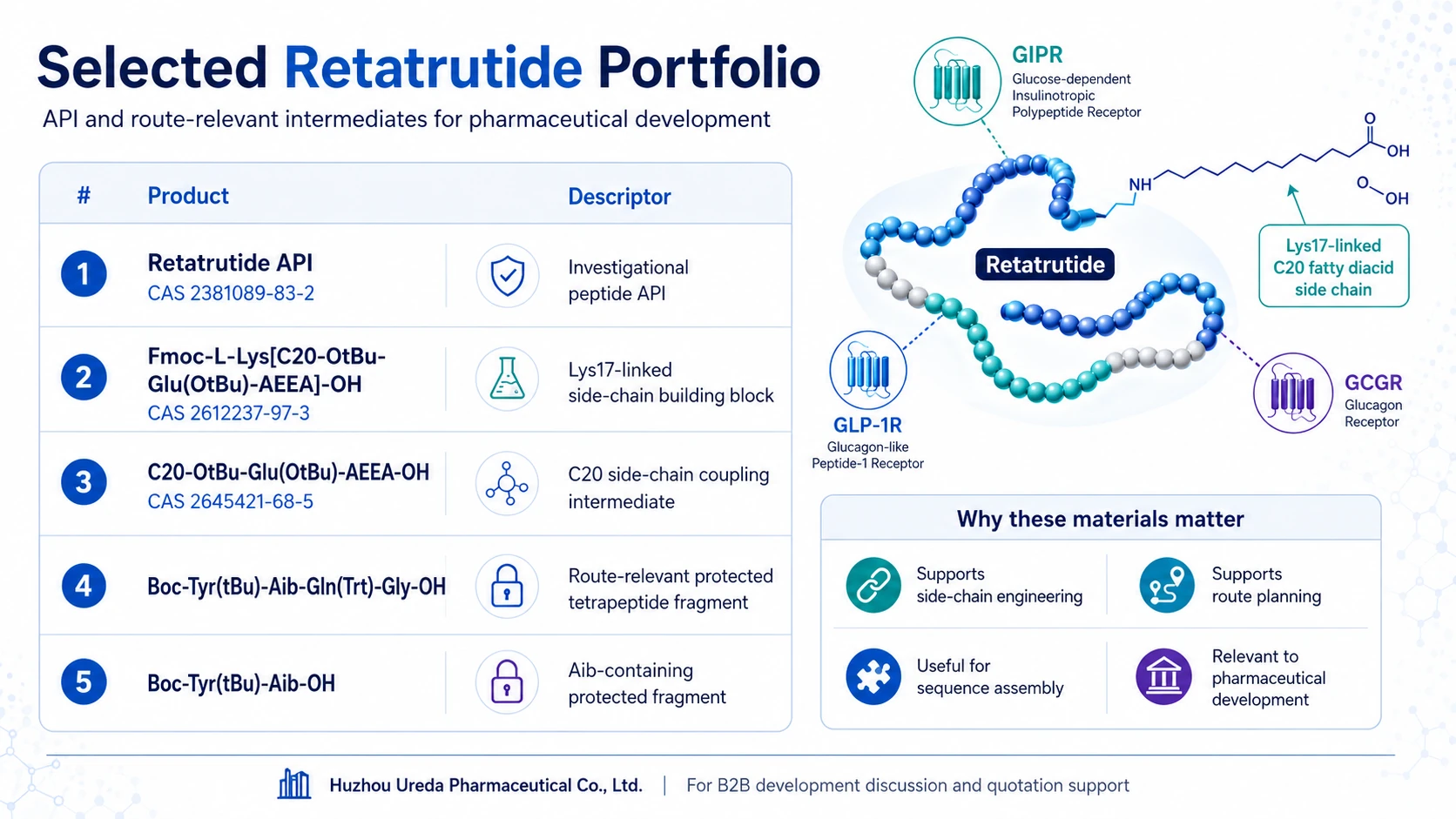
Selected Retatrutide Portfolio
| Product | CAS No. |
|---|---|
| Retatrutide API | 2381089-83-2 |
| Fmoc-L-Lys[C20-OtBu-Glu(OtBu)-AEEA]-OH | 2612237-97-3 |
| C20-OtBu-Glu(OtBu)-AEEA-OH | 2645421-68-5 |
Route-Relevant Protected Fragments Discussed in Public Patent Literature
| Product |
|---|
| Boc-Tyr(tBu)-Aib-Gln(Trt)-Gly-OH |
| Boc-Tyr(tBu)-Aib-OH |
Available support may include:
- Product specification discussion
- COA availability where appropriate
- Packing and storage information
- Sample inquiry coordination
- Quotation support
- Technical clarification regarding the role of the requested material in a Retatrutide development strategy
9. Frequently Asked Questions
FAQ 1: What is Retatrutide?
Retatrutide, also known as LY3437943, is an investigational once-weekly triple hormone receptor agonist designed to activate the receptors for GIP, GLP-1 and glucagon.
FAQ 2: Is Retatrutide approved?
No. Lilly continues to describe Retatrutide as investigational and in clinical development rather than as an approved commercial medicine.
FAQ 3: What is the key structural feature of Retatrutide from an intermediate-sourcing perspective?
A key structural feature is the C20 fatty diacid moiety linked through a spacer to Lys17, which creates demand for specialized side-chain building blocks and coupling materials.
FAQ 4: Which Retatrutide intermediate is most closely associated with its side-chain architecture?
A public preparation patent explicitly identifies the Retatrutide side chain as CAS 2612237-97-3, corresponding to a protected lysine side-chain building block used in the synthesis context described.
FAQ 5: Why do protected peptide fragments matter in Retatrutide synthesis?
Patent literature describes the use of selected protected fragments in Retatrutide preparation to reduce coupling burden and improve process performance in long peptide assembly.
Conclusion: Retatrutide Is a More Selective, More Strategic Intermediate Story
Retatrutide should not be marketed as just another name in the GLP-1 peptide category. It represents a shift toward triple-receptor metabolic peptide engineering, supported by a molecular design that combines:
- A 39-amino-acid peptide framework
- Multi-receptor activity across GIP, GLP-1 and glucagon pathways
- A Lys17-linked C20 fatty diacid side chain
- Route-sensitive protected fragments and side-chain building blocks
For pharmaceutical buyers, the most relevant Retatrutide sourcing discussion is not about collecting the longest possible intermediate list. It is about identifying the few materials that directly shape side-chain engineering and efficient peptide assembly.
That is where strategic intermediates such as 2612237-97-3 and 2645421-68-5, together with route-relevant protected fragments disclosed in public patent literature, become commercially meaningful.
Contact CTA
Looking for Retatrutide API or Key Development Intermediates?
Huzhou Ureda Pharmaceutical Co., Ltd. supports selected Retatrutide API and route-relevant intermediates for pharmaceutical development projects.
For quotation, product specification, COA availability or technical inquiry, please contact:
Huzhou Ureda Pharmaceutical Co., Ltd.
Email: sales@uredapharm.com
Website: www.uredapharm.com
WhatsApp: +86-13867276965